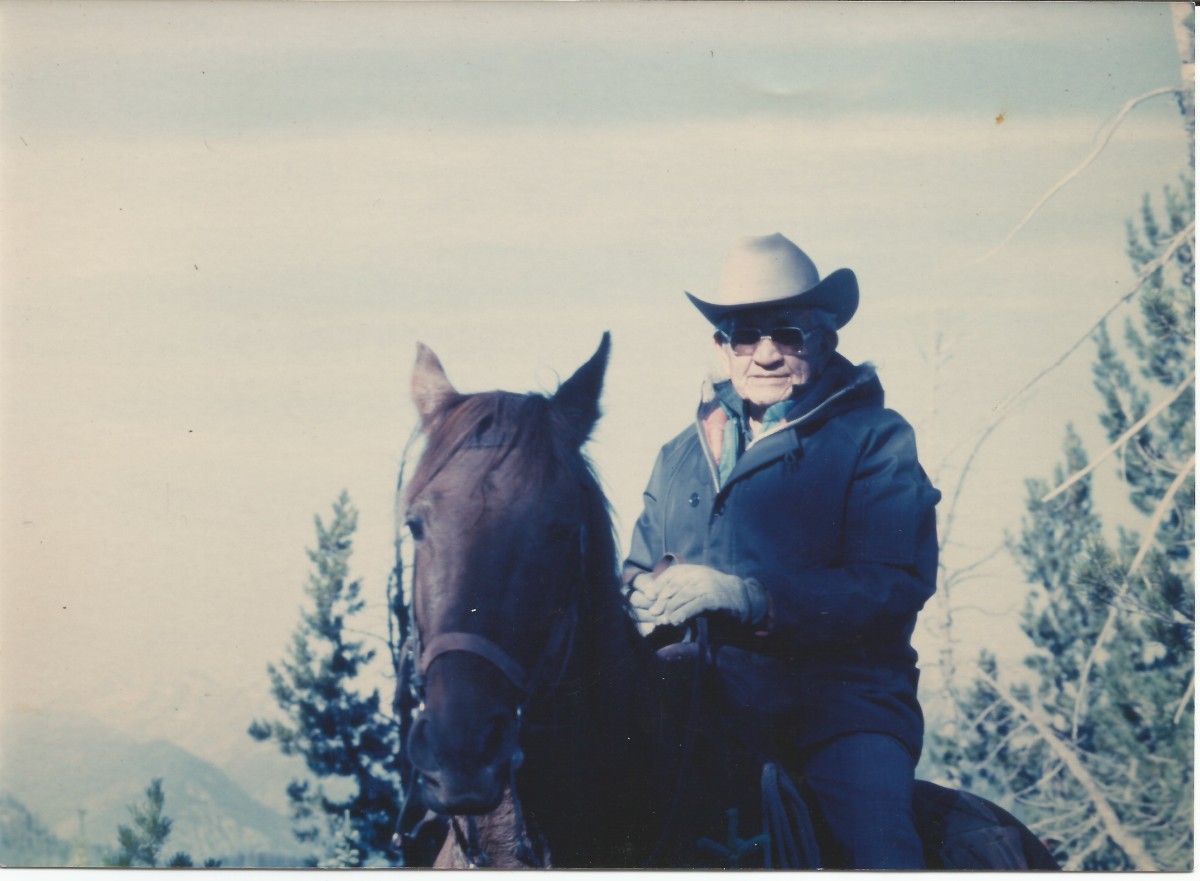
Moses George
In the fall of 1980, Moses George rode on horseback through the NW part of the Wenatchi (P’Squosa) Territory. He and T.B. Charley, another tribal member, were asked by the U.S. Forest Service to look for areas that had previously grown huckleberries. They rode to the Chiwawa Ridge along Raging Creek from the Chiwawa River Road. Chiwawa Ridge is about 2,300 feet elevation with Twin Lakes of Raging Creek and School Lake to the north. Moses was on Dusty, a Forest Service horse, as he overlooked the valley.
He told the Forest Service that the whole area was full of huckleberries in the old days. But the dense under growth has pushed out the berries.
Indians in the past used prescribed fires to contain the brush and limit the fire danger.
The Forest Service has agreed that they were good forest managers. Author Michael Crichton discussed how American Indians successfully managed nature in his books.
This expedition was 125 years after the 1855 Treaty at Walla Walla guaranteed the Wenatchi a 36-square-mile reservation to be located with the P’Squosa Territory which extended from just beyond Lak Wenatchee to what is now East Wenatchee.
The Wenatchi tribe lived and fished for generations at the confluence of the Wenatchee River and Icicle Creek. They would meet with relatives from the Entiat, Sinkiuse, and Chelan tribes to fish, dig roots and pick huckleberries. Until the mid-1800’s Pow Wows were regularly held near the Clovis site in East Wenatchee and where Wenatchee is now located.
The last Pow Wow was in Cashmere in 1931.
This was commemorated in the 1990’s by a rodeo and Pow Wow.
Several Pow Wows have since been held at the Leavenworth Fish Hatchery. Descendants still maintain a grave yard at the Cashmere turnoff from I-90. There are several Indian allotments located throughout the valley.
Moses’ mother, Kwa-ni was from the Kittitas tribe. His father, Lahompt, met her during one of the food gathering expeditions.
The Federal government forced them to move to Kartar Valley on the Colville Indian Reservation but Lahompt’s father, Chilcosahaskt, remained in the Entiat Valley.
Now, 161 years later, there still is no reservation. The area is now densely populated making it impossible to locate a 6-square-mile reservation. But the U.S. Forest Service, U. S. Fish & Wildlife, and Washington State own property that would be suitable.
The Treaty was confirmed by the U.S. Congress which makes it a binding law.
The Wenatchi descendants have evolved from a food gathering community to managers of natural resources such as fish hatcheries, forests, and lumber/plywood mills.
Time has proven they would be good neighbors.
Will the Federal governments’ word be honored? It is inevitable because patience is an Indian virtue that cannot be defeated.
Wendell George writes Go-la’-ka Wa-wal-sh (Raven Speaks). He can be reached via email at wvegeorge@gmail.com or his webpage wvegeorge.wordpress.com. His books are available at the local bookstores, museums, libraries and Amazon. His articles are also available on Google.
Published on May 24, 2016 in the Wenatchee World newspaper.
 Reaching for the sky!